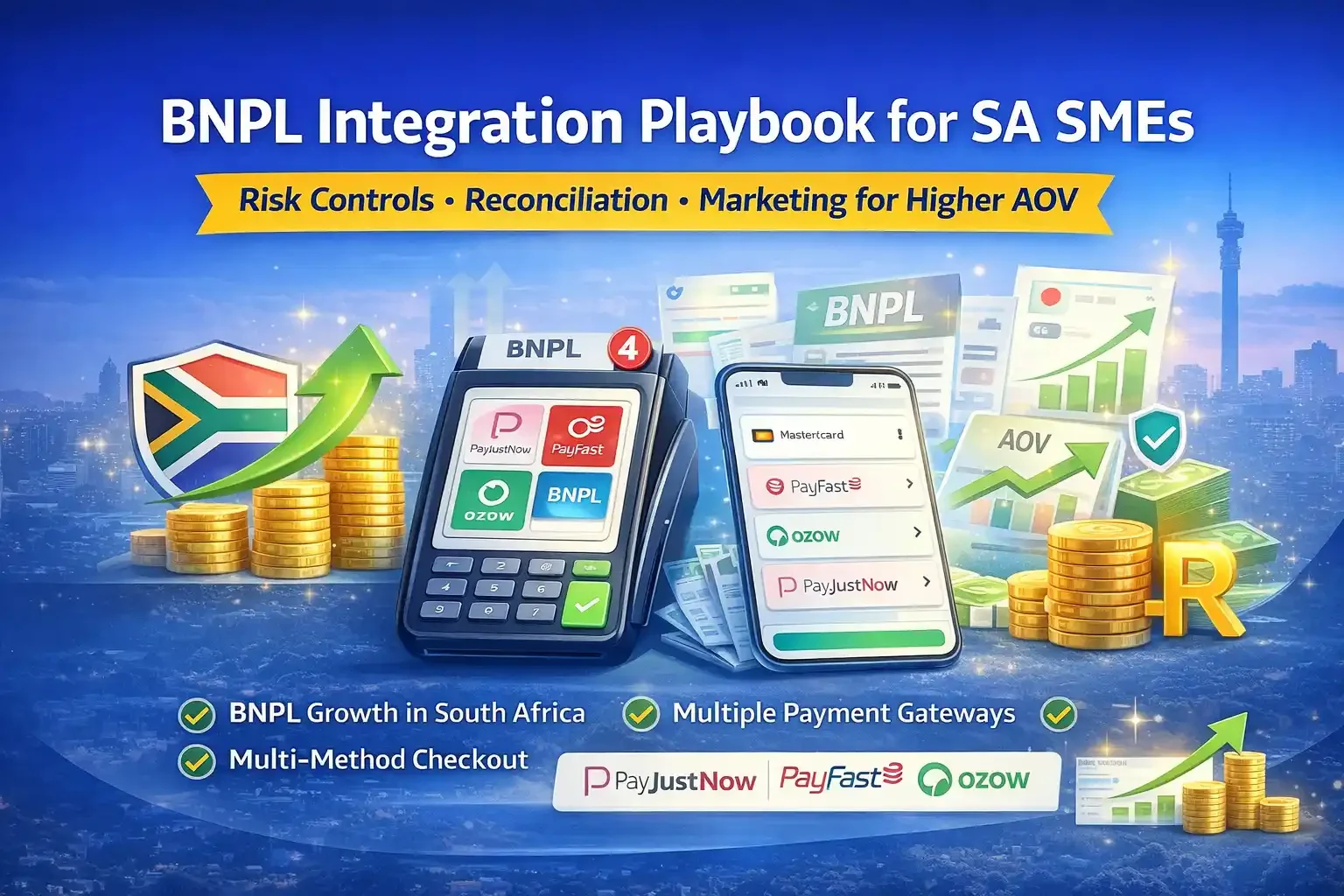
Buy Now, Pay Later (BNPL) and flexible payment methods are rapidly reshaping how South Africans shop online and in-store. In the last 12 months alone, 50% of South Africans have used a BNPL service, while Instant EFT, mobile wallets, and multi-gateway checkouts have become standard expectations rather than nice-to-haves for local shoppers.
| Question | Answer |
|---|---|
| Why are BNPL and flexible payments gaining momentum in SA? | High awareness and usage, younger shoppers' preference for spreading payments, and the rise of gateways like PayFast, Ozow, and PayJustNow are driving rapid adoption and changing checkout expectations. |
| Which SA payment gateways matter most for flexible payments? | Gateways such as PayFast, Yoco, Peach Payments, PayGate and PayU offer cards, Instant EFT, and wallet support, while BNPL is handled by providers like PayJustNow and Payflex. |
| How do multi-gateway setups help SA SMEs? | By offering cards, Instant EFT, mobile wallets, and BNPL at checkout, merchants reduce abandonment, grow average order value, and cater to unbanked or credit-averse customers. |
| What are typical South African payment gateway fees? | For example, PayFast charges around 3.5% + R2 per transaction on standard cards and 2% on Instant EFT, with higher tiers like 4.5% + R5 in some scenarios. |
| Is BNPL risky for small merchants? | Most BNPL providers assume the credit risk, but merchants still need strong reconciliation, refund processes, and customer communication to avoid disputes and cash-flow surprises. |
| How can SMEs practically integrate BNPL? | Start by adding BNPL at checkout via existing gateways, update invoices and terms, train support staff, and run targeted campaigns highlighting "pay in 3" or "pay later" options. |
| What's the outlook for 2025–2026? | SA payment ecosystem reports and BNPL user growth suggest continued expansion of BNPL, Instant EFT, and mobile wallets, with more merchants adopting multi-method checkouts and providers like Ozow and PayJustNow growing their networks. |
Flexible payments have moved from fringe to mainstream in the South African market. 74% of South Africans have heard of BNPL and half have used it in the past year, often to avoid card interest or to spread payments on larger purchases like appliances or electronics.
At the same time, Instant EFT, mobile QR wallets such as SnapScan and Zapper, and international options like PayPal are making it easier for customers to pay the way they prefer. As a result, we see merchants shifting from a single-card gateway to a multi-method checkout approach that pairs BNPL with Instant EFT, mobile wallets, and traditional cards.
To understand how BNPL fits in, we need to view it alongside other fast-growing methods. The typical South African checkout now includes cards, Instant EFT, and one or more mobile wallets, with BNPL layered on top for higher-value or discretionary purchases.
Gateways like PayFast, PayGate, PayU, Yoco, Ozow, SnapScan, and Payflex each cover different pieces of this puzzle. For SMEs, the aim is not to support everything, but to support the combinations that their specific customers are most likely to use.
We increasingly recommend that clients use at least one "full-stack" local gateway and one specialist provider. This typically means pairing a card-and-EFT gateway with BNPL providers and mobile-wallet options to cover different customer segments.
Below is a simplified view of major South African gateways and what they bring to flexible payments:
| Gateway / Provider | Core Methods | Typical Role in Flexible Payments |
|---|---|---|
| PayFast | Cards, Instant EFT, some wallets | All‑rounder for SA e‑commerce, good for SMEs starting with multiple methods. |
| Ozow | Instant EFT only | Low‑card‑usage shoppers, bank‑linked payments, higher trust for card‑averse users. |
| SnapScan / Zapper | QR mobile wallets | Mobile‑first shoppers, in‑store + online QR checkout. |
| PayU / PayGate / Peach Payments | Cards, EFT, recurring | Scalable enterprise and cross‑border transactions with strong fraud tools. |
| PayJustNow / Payflex | BNPL (pay in 3–4) | Higher basket sizes, budget‑conscious customers, younger shoppers. |
PayFast, for example, supports 18+ payment methods and charges around 3.5% + R2 per transaction for standard card payments and 2% for Instant EFT, with some tiers at 4.5% + R5. This makes it a practical starting point for SMEs who want Instant EFT and card coverage without complex custom integrations.
BNPL is now one of the fastest-growing payment options in South Africa. PayJustNow alone has around 2.6 million shoppers and more than 3,000 integrated merchants as of May 2025, with over 100,000 new customers joining in a single month.
BNPL usage is especially strong among younger South Africans. Around 55% of Gen Z and 59% of Millennials report using BNPL in the past 12 months, often to fund larger purchases such as furniture and appliances without taking on revolving credit.
For SMEs, this means BNPL is no longer a "nice add‑on" reserved for large chains. It is a meaningful lever for increasing order value and conversion, particularly in categories like fashion, electronics, and homeware where discretionary spending is sensitive to upfront price.
We recommend treating BNPL integration as a structured project rather than a quick plugin install. A pragmatic playbook for South African SMEs usually follows these steps:
After launch, we track metrics such as BNPL share of checkout, uplift in basket size, and impact on returns. We also monitor operational friction, such as reconciliation and customer support effort, and refine our processes accordingly.
BNPL introduces additional consumer credit into the system, so regulators and the media have rightly raised concerns about over‑indebtedness. As merchants, we must protect our businesses and our customers by adopting sensible risk controls even when the BNPL provider underwrites the credit.
Key risk control practices we follow and recommend:
On the operational side, we regularly reconcile BNPL disbursements against order data and keep a tight handle on refunds and chargebacks. This helps us avoid cash‑flow mismatches and brings early visibility to any emerging risk pattern, such as abuse of return policies via BNPL.
With multiple gateways and BNPL in play, reconciliation can quickly become complex. Each provider pays out on its own schedule, deducts its own fees, and may handle refunds differently, which can catch SMEs off guard.
In our own implementations, we typically:
This disciplined approach protects cash flow and gives management a clear view of how BNPL and other methods affect profitability. It also makes it easier to justify negotiating fees or switching providers when certain methods underperform.
Once BNPL and flexible payment methods are integrated, the next priority is to make them visible. We see the best results when merchants promote payment flexibility across the full customer journey, not just at the final checkout step.
Effective tactics we often use include:
We also test message variations such as "no interest if paid on time" or "only R350 x 3" to see which phrasing resonates best with specific audiences. Over time, this testing can significantly improve conversion and average order values.
Our experience with South African SMEs shows that the strongest performance comes from a multi-method checkout rather than betting on one "hero" payment option. BNPL may drive larger baskets, but Instant EFT often appeals to customers who do not have cards or distrust card payments online.
In practice, this means offering at least:
This combination reduces abandonment due to method unavailability and widens your addressable customer base, including under‑banked shoppers, mobile‑first users, and younger consumers who prefer to spread payments.
Market forecasts indicate that South Africa's BNPL payments could reach around US$1.07 billion in 2024, with a projected compound annual growth rate of approximately 10.6% through 2029. At the same time, real‑time payments and Instant EFT are expanding as banks and fintechs roll out new capabilities.
We expect the next two years to bring:
For South African SMEs, the opportunity lies in moving early enough to benefit from higher conversion and basket sizes, while staying disciplined about risk, reconciliation, and customer communication.
BNPL and flexible payments are no longer experimental in South Africa; they are central to how local consumers expect to pay online and in-store. With high BNPL awareness, strong usage among younger generations, and rapid growth of providers such as PayJustNow and Payflex, we anticipate even greater momentum through 2025–2026.
As a business, our approach is to combine BNPL with Instant EFT, mobile wallets, and robust local gateways like PayFast, Ozow, and others. By following a structured integration playbook, tightening risk and reconciliation processes, and actively marketing flexible payment options, South African SMEs can capture higher average order values, better conversion, and deeper customer loyalty while keeping their operations sustainable and compliant.

