
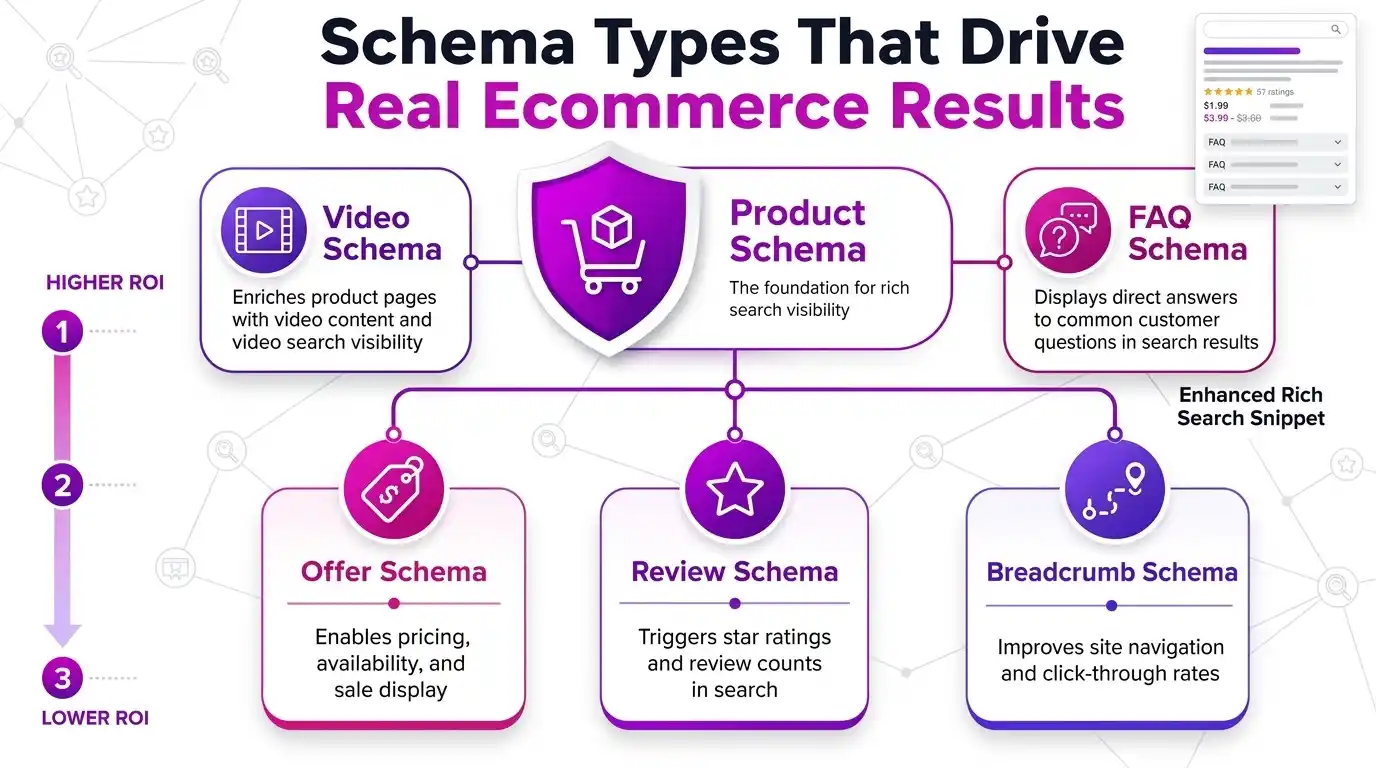
Key Takeaway: As AI shopping assistants become mainstream, simply having a visually appealing website isn't enough - your store needs to be machine-readable so AI agents can find, trust, and recommend your products. By focusing on Generative Engine Optimization (GEO) through clean schema markup, structured product data, and answer-first content, businesses of any size can ensure they show up in AI-generated recommendations rather than losing customers to competitors with cleaner data. Ultimately, making your ecommerce platform AI-ready isn't just a one-time technical upgrade, but an ongoing essential for staying visible and competitive in modern search.
Most retail homepages still fail basic machine-readability checks right now, in late 2026 [1]. That means while you're reading this, AI shopping agents are quietly skipping over stores that look fine to humans but invisible to machines. Ecommerce AI-ready and future-proof GEO isn't a buzzword anymore, it's the difference between showing up in an AI-generated answer or disappearing entirely. Here's what local marketers need to understand before the gap gets wider.
AI-ready for ecommerce platforms means your product pages, pricing, and availability are structured so AI systems can read and trust them without guessing. This goes beyond having a nice website, it means clean schema markup, consistent product data, and content written so an answer engine can lift it directly into a response.
Microsoft's Age of AI Shopping playbook formalized this standard for merchants in late 2026, giving retailers a checklist for what "ready" actually looks like [2]. A store selling hiking boots, for example, needs structured size, stock, and shipping data that an AI agent can parse instantly, not buried in a PDF spec sheet.
Regular geolocation tells a website where a shopper is standing. Future-proof GEO, generative engine optimization, is about making sure AI engines like ChatGPT or Copilot can find, understand, and recommend your products regardless of where the search happens. It blends location signals with machine-readable content strategy.
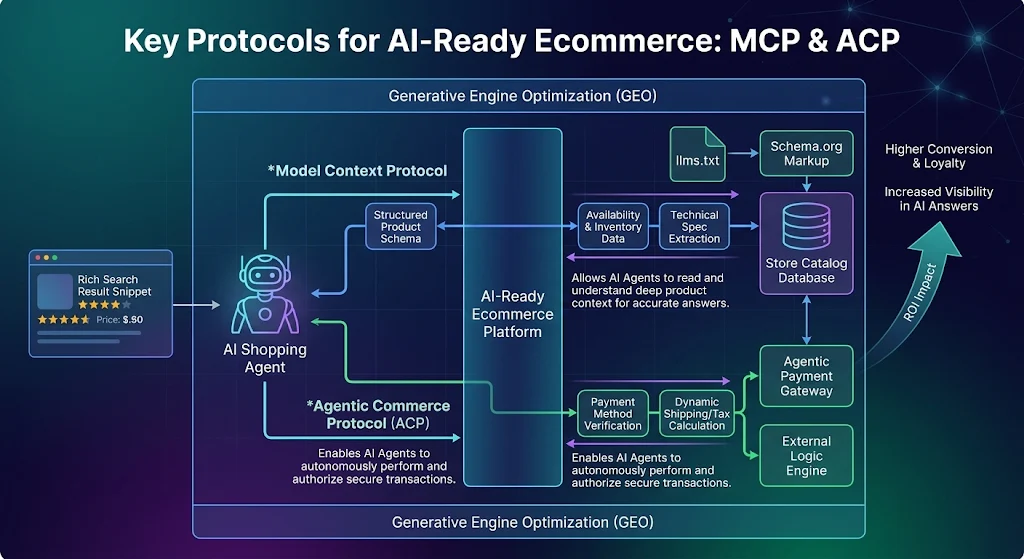
Techniques include llms.txt files, structured schemas, and answer-first content blocks that directly respond to likely shopper questions [3][4]. A regional furniture retailer might use this to make sure an AI assistant recommends their sectional sofa by name, not just "a furniture store nearby."
Benchmarks show most ecommerce sites are not yet AI-ready, even though merchants are racing to catch up [1]. The infrastructure for AI agents, protocols, catalogs, payment rails, is largely built and ready on the agent side, but individual stores lag behind in adoption [5][6].
This creates real risk. If your platform isn't AI-ready, AI-driven shopping assistants may simply route customers to a competitor whose data is cleaner. Naridon data links GEO maturity directly to AI answer visibility and revenue outcomes, meaning the gap isn't just technical, it's financial [7].
Future-proof ecommerce platforms share a few traits: structured product schema, support for emerging protocols like MCP and ACP, fast-loading machine-readable pages, and content written in direct, answer-style language [3]. These protocols are becoming pillars of future-proof GEO because they let AI agents interact with inventory and checkout systems directly [5].
Platforms with built-in AI-ready capabilities are increasingly common in 2026 roundups of GEO and LLM-ready tools, many offering plugins that auto-generate schema and llms.txt files [8]. Small and mid-size stores don't need custom engineering, many tools now handle this with templates.
Older ecommerce systems can become AI-ready, but it takes more than a plugin install. The technical bar for AI-ready structured data is strict, and surprisingly few stores meet it even after attempting upgrades [1]. Common mistakes include adding generic schema without validating it, ignoring product attribute consistency, and treating GEO as a one-time project instead of ongoing maintenance.
The difference between AI-ready and AI-powered ecommerce matters here too. AI-powered might mean you have a chatbot or recommendation engine. AI-ready means your underlying data structure can be read and trusted by any AI system, not just your own tools [9]. You can have one without the other, and many stores do.
| Dimension | AI-Powered Ecommerce | AI-Ready Ecommerce |
|---|---|---|
| Primary Audience | Human visitors already on your site | External AI shopping agents and answer engines |
| Core Purpose | Personalize browsing, automate support, and boost conversions | Ensure your catalog is discoverable, readable, and trustworthy to machines |
| Underlying Tech | Chatbots, recommendation engines, dynamic pricing tools | Schema markup, llms.txt files, clean product feeds, MCP/ACP protocols |
| Main Risk if Missing | Lower on-site conversion rates and manual customer support load | Total invisibility in AI-generated shopping answers |
Imagine you run a local outdoor gear and footwear shop:
llms.txt files so AI agents can quote your specs directly.Having an AI-powered store without being AI-ready is like having a brilliantly staffed retail shop tucked down an unmarked alleyway with no street signs—once people walk in, the service is great, but AI agents won't know how to direct shoppers to your door. Conversely, being AI-ready gets external AI assistants to send high-intent buyers straight to your product pages, where your AI-powered tools can help close the sale.
Costs for AI-ready GEO technology vary widely, from affordable SaaS tools for small catalogs to larger investments for enterprise retailers needing custom protocol integration [4][8]. Small ecommerce stores do need some level of AI-ready GEO, since even modest product catalogs can be excluded from AI answers without basic schema work.
For international shipping, future-proof GEO helps by letting AI agents pull accurate, localized shipping rules and availability instead of guessing based on outdated location data. Alternatives to full AI-ready overhauls include hybrid approaches, like using a GEO-focused plugin while planning a longer migration [3]. Strategic guidance from late 2026 suggests going beyond basic GEO toward full AI-agent readiness as the next competitive layer, since agent-driven shopping is expected to accelerate quickly [6][7].
Ecommerce AI-ready and future-proof GEO aren't optional upgrades anymore, they're basic visibility requirements as AI shopping assistants become mainstream. Start small: audit your schema, fix catalog gaps, and treat GEO as an ongoing habit, not a one-time fix.
Tags: ecommerce AI-ready, future-proof GEO, generative engine optimization, AI shopping agents, structured data, llms.txt, agentic commerce, ecommerce platforms, schema markup, AI-powered ecommerce, retail technology, MCP ACP protocols

